
How Fiber Optic Cables Enable Precise Leak Detection
In the oil and gas industry, leaks are more than operational setbacks—they pose serious environmental, financial, and safety risks. Detecting them quickly and accurately is vital to minimizing damage and ensuring regulatory compliance. Traditional detection methods often rely on indirect measurements, scheduled inspections, or visual confirmation, which can lead to delays, false alarms, or undetected leaks in remote areas.
That’s why many pipeline operators are now turning to a cutting-edge solution: fibre optic sensing technology. At AXIA, we deploy fibre optic cables as part of our advanced monitoring infrastructure to deliver real-time, pinpoint-accurate leak detection across entire pipeline networks.
What Makes Fibre Optic Technology So Effective?
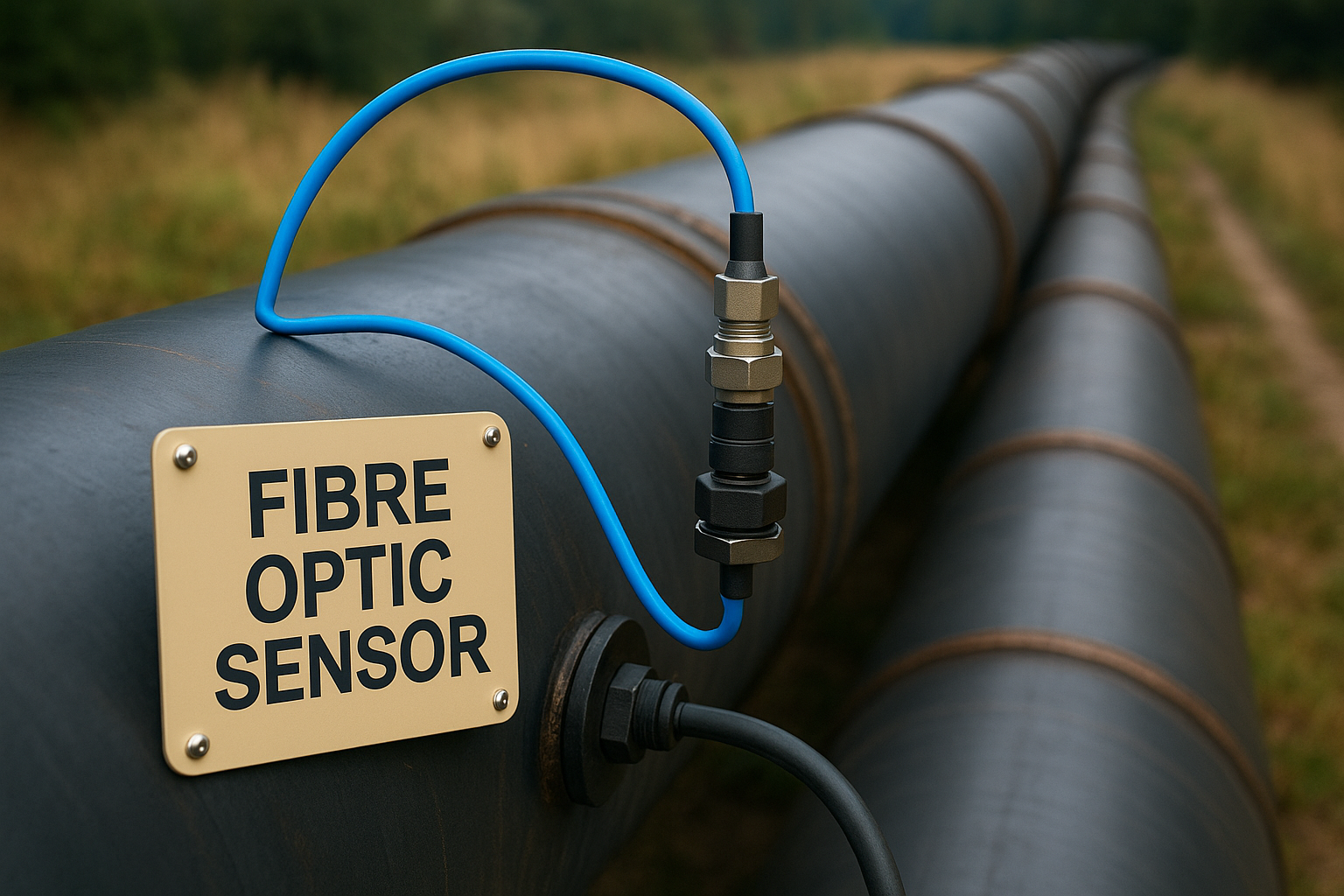
Unlike conventional sensors that are installed at intervals along a pipeline, fibre optic cables run continuously along its length, acting as a distributed sensor system. These cables transmit light signals, and when there’s a change in temperature, pressure, strain, or acoustic vibration along the cable, it creates a measurable change in the light signal.
Using specialized analysis, this data can be interpreted to detect, locate, and characterize events like a leak with remarkable precision.
Key Fibre Optic Technologies for Leak Detection
1. Distributed Temperature Sensing (DTS)
Leaks often cause a temperature change in the surrounding environment. For example, escaping fluids may be cooler or hotter than the ambient soil. DTS systems use fibre optic cables to detect these temperature anomalies at resolutions of less than one meter, identifying:
- Small leaks before they escalate
- Underground or underwater temperature shifts
- Changes in flow consistency
2. Distributed Acoustic Sensing (DAS)
DAS systems transform a fibre optic cable into an array of acoustic sensors that “listen” to pipeline activity. These systems detect:
- Acoustic signatures from gas escaping under pressure
- Ground vibrations caused by pipeline tampering or rupture
- Unusual operational sounds such as cavitation or turbulence
AXIA’s DAS-powered systems can pinpoint a leak to within a few meters, allowing teams to respond with
speed and confidence.
3. Real-Time Monitoring and Alerts
Fibre optic systems operate continuously and in real time, enabling 24/7 monitoring without the need for manual inspection or power at every sensing point. When a leak is detected, alerts are automatically sent to the control center with detailed information including:
- Leak location (within meters)
- Estimated leak size or rate
- Time of detection
- Associated acoustic or temperature profiles
Benefits to Operators
By leveraging fibre optics, pipeline operators gain:
- Immediate detection of leaks or anomalies
- Minimized downtime through faster intervention
- Improved safety and environmental compliance
- Cost savings by reducing false alarms and unnecessary excavations
- Greater visibility into pipeline health, even in remote areas
AXIA’s Fibre Optic Advantage
At AXIA, we design, install, and maintain integrated fibre optic sensing systems that work seamlessly with SCADA and AI-driven platforms. Our solutions are tailored to your pipeline environment—be it subsea, desert, urban, or mountainous terrain.
Conclusion
Fibre optic sensing is revolutionizing pipeline leak detection. By turning a single strand of cable into thousands of virtual sensors, this technology empowers operators to act faster, respond smarter, and protect both assets and ecosystems.
At AXIA, we don’t just monitor pipelines—we make them intelligent. Ready to upgrade your leak detection strategy?
Let us know if you’d like to explore a custom fibre optic solution for your pipeline.